
A Remote Worker's Relocation Guide
Turn your work-from-anywhere dream into a well-planned reality.

The goal isn't to escape your life. It's to build one you don't have to leave behind.

Hi Superstar,
The dream is simple.
Keep the job you already love, but wake up somewhere different.
Maybe it’s a beach town where your mornings begin with a walk by the ocean.
Maybe it’s a quieter city with a lower cost of living, or maybe it’s simply being closer to the people you love without giving up the career you’ve worked so hard to build.
For many remote workers, that’s the real definition of freedom.
But here’s what most people don’t realize:
Relocating as a remote worker isn’t about booking a one-way ticket. It’s about making a series of smart decisions in the right order. The people who relocate successfully aren’t necessarily luckier than everyone else. They plan and ask the right questions before they pack their bags.
How to Relocate as a Remote Worker
A successful relocation isn’t complicated. It just requires getting the sequence right. Here’s exactly where to start:
Step 1: Get Your Employer's Approval In Writing
This is the first conversation you should have, not the last. Just because your job is remote doesn’t automatically mean you can work from anywhere in the world. Some companies are legally registered to employ people only in specific countries or states. Others have tax, payroll, insurance, or compliance restrictions that determine where employees can live.
Before making any plans, ask a clear question:
“Can I work remotely from [country] on a long-term basis? Are there any restrictions I should know about?”
Getting a written confirmation protects both you and your employer. It also prevents the unpleasant surprise of discovering you’ve relocated somewhere your company legally can’t support. If your company works with an Employer of Record (EOR) such as Deel or Remote, relocating may be much easier. These platforms allow companies to legally employ and pay people across multiple countries without opening local entities. If you’re unsure, ask your HR team whether an EOR is already in place.
Step 2: Be Honest About the Time Zone
Time zones are one of the biggest reasons remote relocations fail. If your role requires collaboration with teammates, customer meetings, or overlap hours, make sure your new location allows you to keep those commitments without burning yourself out. Before committing, compare your proposed schedule against your team’s working hours using a tool like World Time Buddy to map your would-be day against your team’s hours.
Step 3: Make Sure You Have the Legal Right to Stay
This is where many people unknowingly get themselves into trouble. A tourist visa isn’t necessarily permission to work remotely; while some countries tolerate remote work under tourist status, many are introducing clearer rules and enforcing them. If you’re planning to stay longer than a short vacation, research whether your destination offers a digital nomad visa, remote work visa, or another residency option that legally allows you to live and work there.
Step 4: Don't Ignore Taxes
Taxes aren’t exciting. They’re also one of the most expensive mistakes remote workers make. Many countries consider you a tax resident once you have lived there for a certain amount of time, often around 183 days, though the rules vary. That could affect where you pay taxes, what you owe, and whether additional reporting requirements apply. Before relocating, spend an hour speaking with a cross-border tax professional. It’s far less expensive than discovering you’ve accidentally created a tax problem in two different countries. If you’re beginning your research, resources like Taxes for Expats and Nomad Capitalist provide useful overviews, though they should never replace advice tailored to your personal situation.
Step 5: Figure Out Your Health Coverage Before You Need It
Nobody plans to get sick while living abroad, but medical emergencies don’t wait until you’ve sorted your paperwork. Many domestic health insurance plans provide little or no coverage outside your home country. Before relocating, understand exactly what your insurance covers, what it doesn’t, and whether you’ll need international health insurance. Check out SafetyWing, Cigna Global, and IMG Global
Step 6: Test Everything Before You Commit
Test the internet before you commit. Your income depends on it. Check real speeds for your destination on Speedtest’s Global Index, and always have a backup (a second SIM, a nearby coworking space).
Do a trial run if you can. A few weeks working from the destination reveals the real cost of living, the noise, the rhythm, everything a listing won’t tell you. Cross-check costs on Numbeo and community insight on Nomad List.
Budget beyond the flight. Deposits, visa fees, insurance, setup costs, and a buffer for the first slow month. Relocations always cost more than the spreadsheet says.
Latest Remote Work Trends
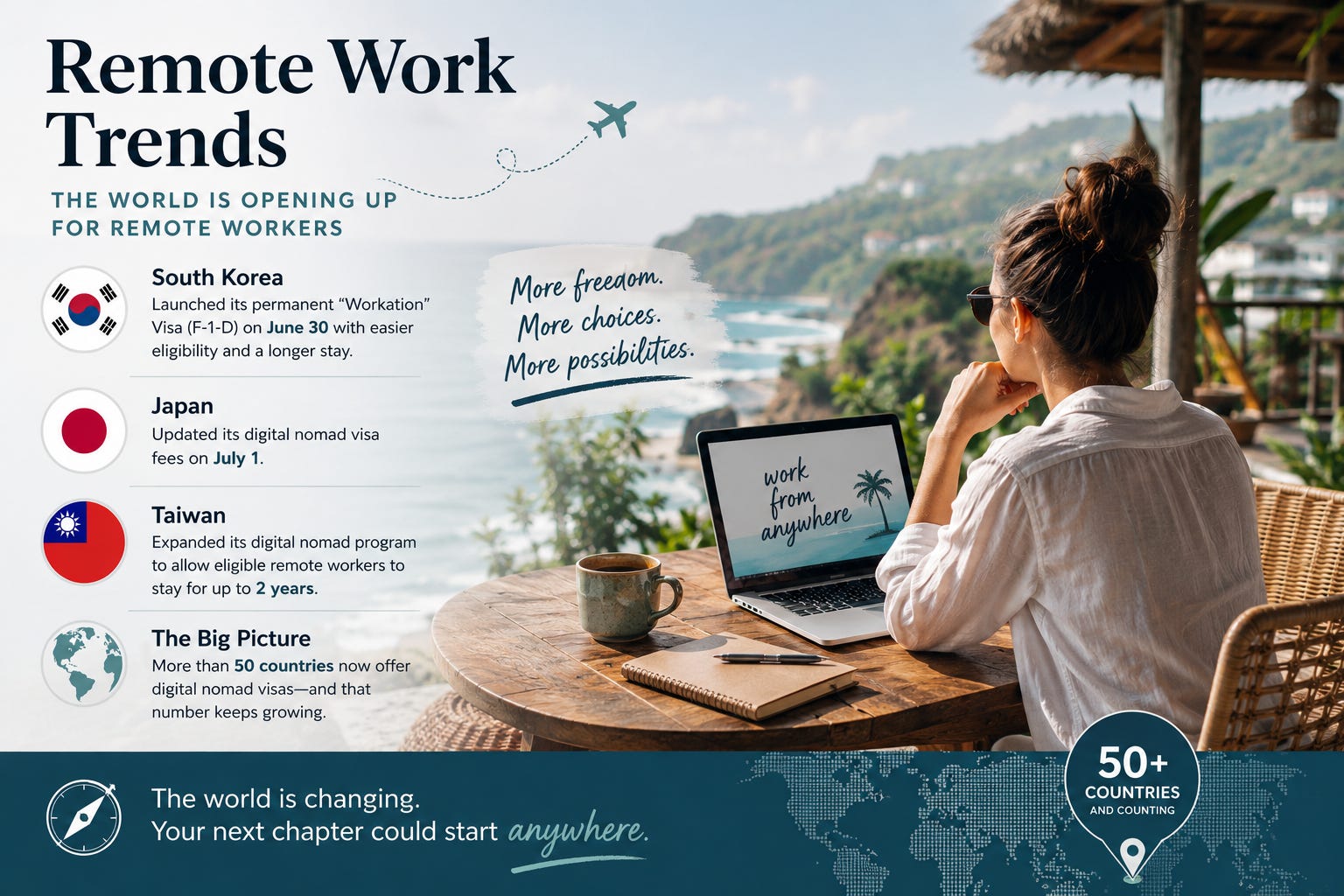
Newer doors are opening. South Korea officially launched its “workation” visa (F-1-D) on June 30, replacing its pilot program with easier eligibility requirements and a longer maximum stay. Japan updated its digital nomad visa on July 1, continuing to refine one of Asia's newest pathways for location-independent professionals.
Meanwhile, Taiwan has expanded its digital nomad program to allow eligible remote workers to stay for up to two years, joining a growing list of Asian countries competing for global talent.
Latest Worldwide Fully Remote Jobs Currently Hiring
At InclusivelyRemote, we curate remote opportunities from companies that believe in healthy work culture, flexible schedules, and fair contracts, so you can grow your career without burning out. Here are some of the latest roles on the site:
Fundraising Specialist at Catalyst Now ($2000 - $5500 / month)
Communications Officer (Media Relations) at Coefficient Giving ($145000 - $166000 / year)
Senior Product Manager, Fraud and Compliance at Remote ($149000 - $168000 / year)
Database Administrator at Global Fund for Women ($85000 - $135000 / year)
→ Tip: apply within 48 hours. Early applicants get seen first.
Hidden Remote Opportunities From our Network
Sofia Marrero is hiring a Senior Customer Success Manager - APAC for Multiplier
Hannah Pelletier is hiring a Product Marketing Manager for Prerender.io
Andre Burt is hiring for the Luminous AI Fellowship Program Fall 2026
Kyle Connors is hiring for a Product Manager and a Backend Engineer
Alyssa Dulin is hiring a Growth Manager and a Senior Creator for KIT
One last thing before you go.
Relocating as a remote worker is one of the great privileges of this era of work. But it rewards preparation, not impulse. Confirm the job, sort the visa, understand the tax, protect your health, then go enjoy the view you’ve been dreaming about. Do it in that order and the whole thing becomes not just possible, but smooth.
Pick one step this week. Ask your employer the question. Read one country’s visa page. Check whether your coverage travels. Momentum starts with a single move.
Dreaming of this with a friend? Forward it to them. The best remote lives are built together, and someone you know is closer to their move than they think.
Rooting for you, as always 🫶🏼💡
Yours truly, The InclusivelyRemote Team
LinkedIn | Twitter | Instagram | TikTok | Newsletter
The relocation freedom in this guide rests on a supply number worth naming: remote and hybrid roles are about 20% of listings but pull nearly 60% of all applications (RTO trackers, 2026). That imbalance is the leverage. It is also why strict five-day office mandates run close to double the attrition of flexible ones (TalentLMS, 2026), hardest on senior people who have the most places to go. Relocating on a remote role is not only a lifestyle move, it is sitting on the scarcest surface in the market. Worth asking before you pack: is your role remote because the work is truly location independent, or because your employer has not decided to pull it back yet?
Zia. AI career strategist for Indian professionals. itszia.ai